Our History
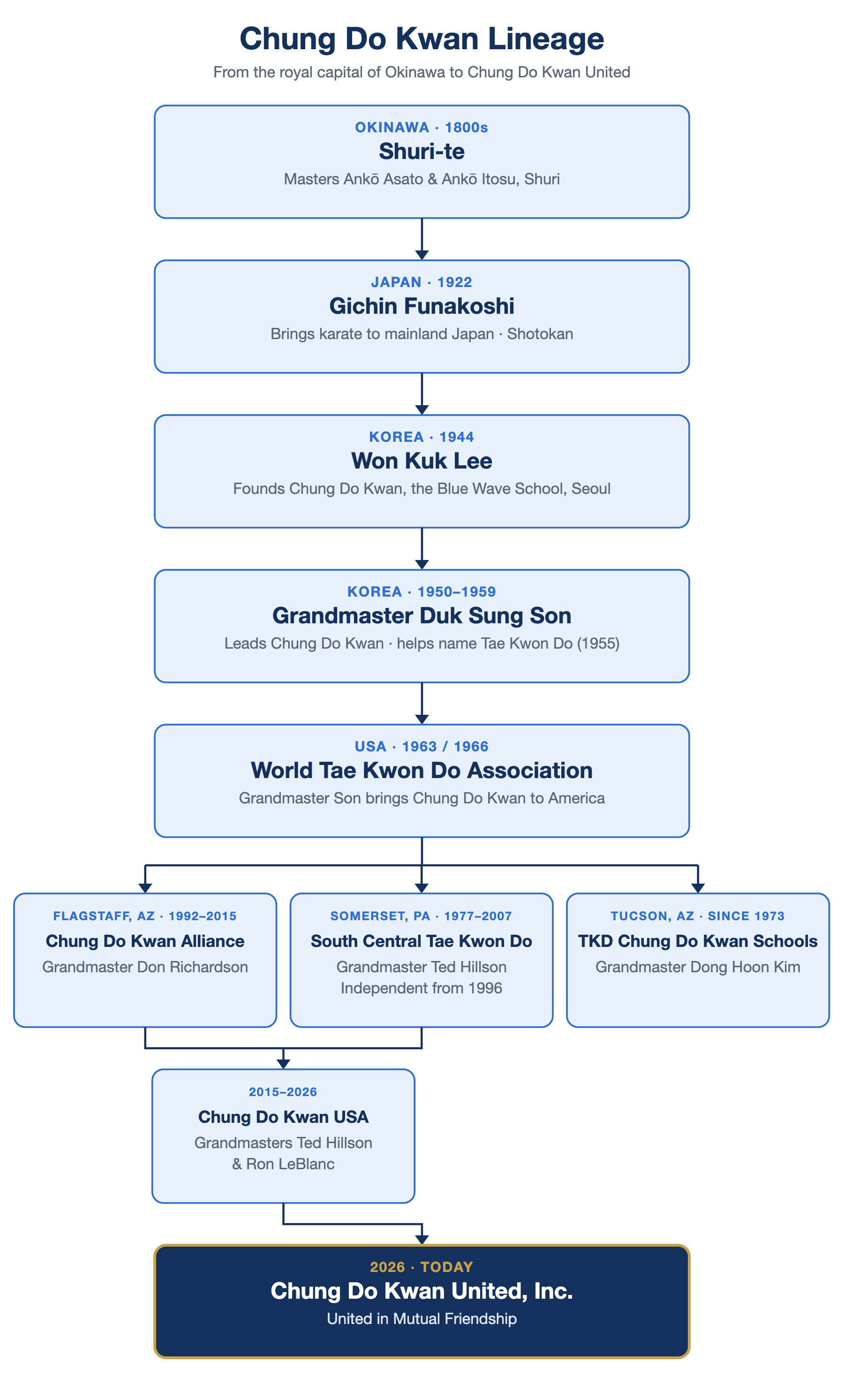
Chung Do Kwan Tae Kwon Do traces an unbroken line from the royal capital of Okinawa, through Japan and Korea, to the schools of Chung Do Kwan United today.
Origins and Evolution
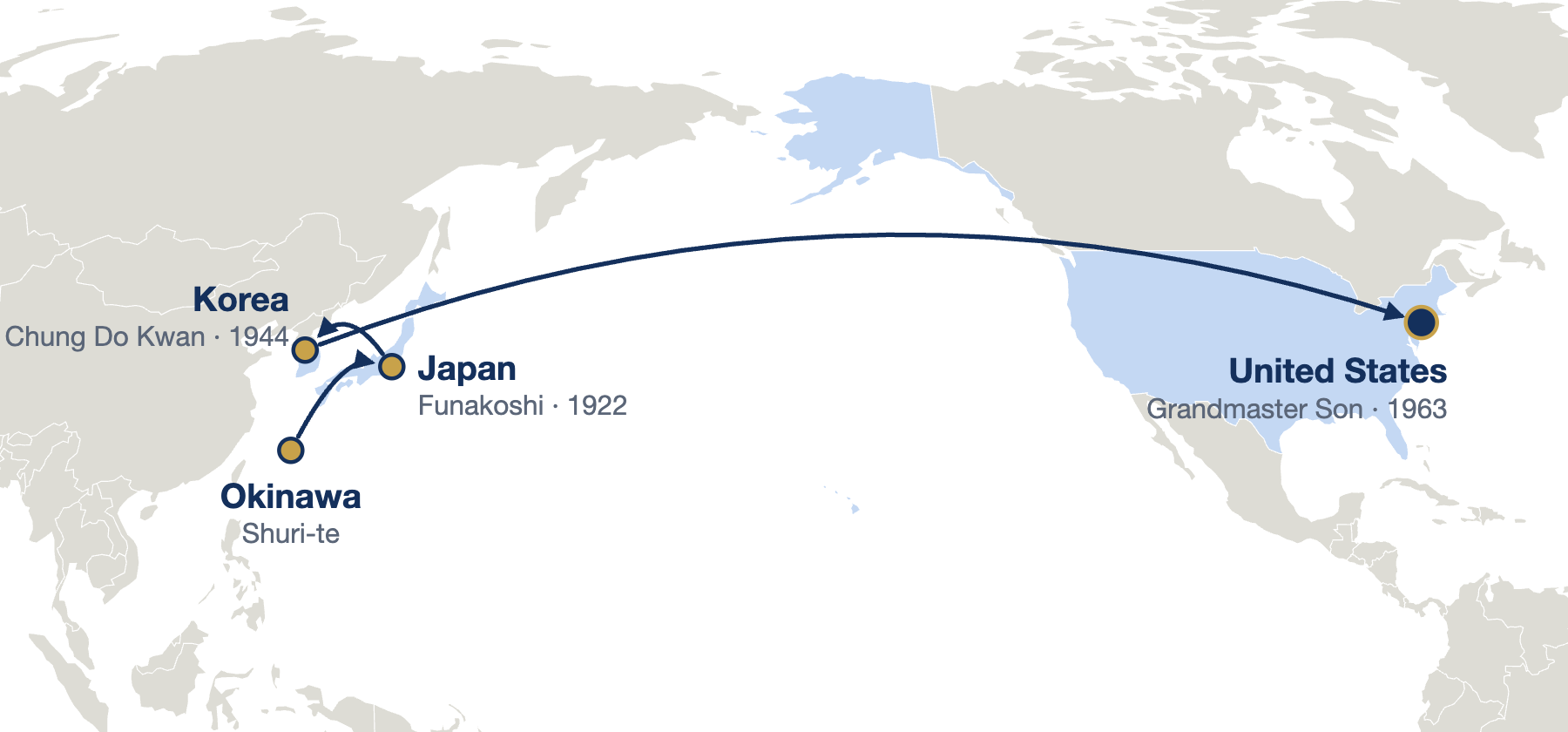
Chung Do Kwan's roots reach back to Shuri, the royal capital of the Ryukyu Kingdom on Okinawa. For centuries the kingdom balanced its ties to both China and Japan, and among the families of the royal court a refined fighting art took shape: Shuri-te.
Gichin Funakoshi, born in Shuri in 1868, trained under masters Ankō Asato and Ankō Itosu. In 1922 he brought karate to mainland Japan, where his style became known as Shotokan, named for his pen name, Shōtō ("waving pines").
Among those who trained under Funakoshi in Tokyo was a young Korean law student, Won Kuk Lee. In September 1944 Lee opened Chung Do Kwan, the "Blue Wave School," in Seoul. It was one of the first Korean martial arts schools, or kwans. Many of his early students were police officers, and the school's practical, powerful approach soon set it apart from its Shotokan roots.
Lee's senior student, Duk Sung Son, led Chung Do Kwan from 1950 to 1959. He built it into the largest school in Korea and served as chief instructor to the South Korean Army and the U.S. 8th Army. In 1955 he helped choose the name Tae Kwon Do for the Korean national martial art. Several other kwans, including Oh Do Kwan, Jung Do Kwan, Kuk Mu Kwan and Chung Ryong Kwan, grew directly from Chung Do Kwan.
In 1963 Grandmaster Son brought Chung Do Kwan to the United States, first teaching in New York's Central Park and later at West Point, Princeton, NYU, Brown, Fordham and Stony Brook. In 1966 he founded the World Tae Kwon Do Association, and in 1968 he published Korean Karate: The Art of Tae Kwon Do.
Journey at a Glance
Key Milestones
1868 — Gichin Funakoshi is born in Shuri, Okinawa
1922 — Funakoshi introduces karate to mainland Japan
1944 — Won Kuk Lee founds Chung Do Kwan in Seoul
1950 — Duk Sung Son becomes head of Chung Do Kwan
1955 — The name "Tae Kwon Do" is chosen for the Korean martial art
1963 — Grandmaster Son brings Chung Do Kwan to the United States
1964 — Grandmaster Son appears on the cover of Esquire
1966 — The World Tae Kwon Do Association is founded
1973 — Grandmaster Dong Hoon Kim opens his school in Tucson, Arizona
1977 — Grandmaster Ted Hillson founds South Central Tae Kwon Do in Somerset, Pennsylvania
1992 — Grandmaster Don Richardson founds the Chung Do Kwan Alliance in Flagstaff, Arizona
2015 — The Chung Do Kwan Alliance becomes Chung Do Kwan USA, incorporated in Idaho
2026 — Chung Do Kwan United, Inc. is founded, incorporated in Arizona
Our Legacy
Grandmaster Son’s students carried the art across the country. In 1977, Grandmaster Ted Hillson founded South Central Tae Kwon Do in Somerset, Pennsylvania, which grew to include schools and clubs across the region. It was part of the World Tae Kwon Do Association until 1996, when it became an independent organization, and continued through 2007. Grandmaster Hillson later carried that lineage into Chung Do Kwan USA.
In the early 1990s, as the WTA’s member schools spread into independent organizations, West Coast schools formed their own so students no longer had to travel East for tournaments and testing; the WTA itself continued under Grandmaster Son. In 1992, Grandmaster Don Richardson of Flagstaff, Arizona founded the Chung Do Kwan Alliance, whose summer camps in Flagstaff began a tradition that continues today. Grandmaster Dong Hoon Kim, the WTA’s West Coast Director, led Tae Kwon Do Chung Do Kwan Schools from Tucson, where he had opened his school in 1973.
In 2015, the Chung Do Kwan Alliance grew into Chung Do Kwan USA, an Idaho corporation led by Grandmasters Ted Hillson and Ron LeBlanc. It united practitioners of the art first taught by Won Kuk Lee and brought to America by Duk Sung Son, under the motto "United in Mutual Friendship."
On March 6, 2026, Chung Do Kwan United, Inc., incorporated in Arizona, carried that lineage forward as a 501(c)(3) nonprofit. Its founders are Grandmaster Ted Hillson, Grandmaster Michael Conboy, Master Ron Gans, Master Alexander Laszlo, Master Joe Montanez, Master Brad Bransky, Master Tony Graham, Master Lou Blazquez, Master Annemarie Herrndorf, Master Mike Vogler and Master Chris Yao.